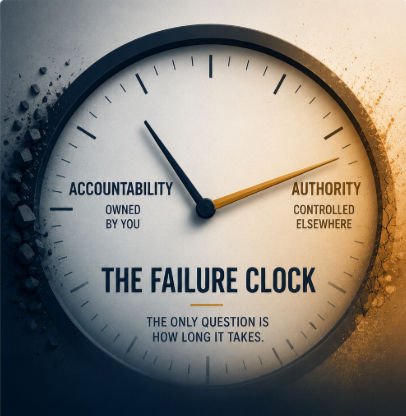
THE FAILURE CLOCK

Executive Summary
Organizations routinely hold people accountable for outcomes they do not possess sufficient authority to control.
A manager owns a performance target but cannot change staffing. An engineer owns technical integrity but cannot stop a launch. A safety representative carries regulatory responsibility while remaining subordinate to leaders controlling schedule and cost. Employees are expected to correct failures produced by systems they cannot modify. Frontline teams are measured against requirements they have no ability to reject, renegotiate, or redesign.
The language of accountability remains intact.
The operating structure beneath it does not.
The resulting failure is often attributed to execution, judgment, communication, culture, ethics, or individual performance. Those explanations may describe what becomes visible at the end of the process. They do not necessarily explain what created the conditions for failure in the first place.
The structural problem is simpler:
Accountability without decision-making authority will only lead to failure. The only question is how long it takes for that failure to happen.
The evidence is visible across some of the most consequential organizational failures of the modern era.
General Motors assigned teams responsibility for investigating safety defects while reserving recall authority elsewhere. Boeing delegated regulatory responsibilities to employees who remained subordinate to the organization they were expected to independently assess. Challenger engineers carried technical responsibility for solid rocket boosters but could not control the final launch decision. UK Post Office subpostmasters were financially accountable for discrepancies generated by a system they neither controlled nor could independently inspect.
At Wells Fargo, Volkswagen, and Toshiba, employees were expected to achieve requirements they had little practical authority to change. When reality and requirement diverged, the organizational response shifted toward gaming metrics, concealing information, manufacturing results, or punishing the people closest to the failure.
Deepwater Horizon demonstrates an additional complication: authority can formally exist and still be functionally unusable.
These cases differ dramatically in industry, severity, governance, and outcome. What connects them is not identical misconduct. It is the separation between who carried accountability and who controlled the decisions necessary to satisfy it.
These cases are not presented to suggest that authority-accountability mismatch was the sole cause of every failure examined. General Motors, Boeing, Challenger, and Post Office Horizon provide the most direct evidence of responsibility being separated from consequential decision control. Wells Fargo, Volkswagen, Toshiba, and Deepwater Horizon demonstrate the predictable organizational adaptations and governance risks that emerge when authority is constrained, unusable, or held elsewhere.
The failure clock moved at different speeds.
Challenger reached catastrophe in seconds.
Boeing took years.
General Motors took more than a decade.
The Horizon scandal persisted for roughly two decades before the structural failure became institutionally undeniable.
The difference was not whether the underlying structure could fail.
The difference was consequence latency: how long the organization could operate before the accumulated consequences of its authority-accountability mismatch became impossible to absorb, redirect, conceal, or deny.
1. Accountability Is an Operating Mechanism, Not a Management Phrase
Accountability is often treated as a behavioral expectation.
Someone owns the number.
Someone owns the project.
Someone owns safety.
Someone owns quality.
Someone owns the customer.
Someone owns the result.
But declaring ownership does not create the capability to influence an outcome.
For accountability to function as an operating mechanism, the accountable role must possess sufficient decision rights over the variables that materially determine the result.
That does not mean every accountable employee requires unlimited authority.
It means something much more practical:
Authority must be sufficient to match the scope of the accountability assigned.
If an individual is accountable for an outcome but cannot change the resources, requirements, process, timing, standards, staffing, systems, or decisions materially determining that outcome, the organization has not created accountability.
It has created exposure.
The individual remains visible when the outcome fails while control over the conditions producing the outcome exists somewhere else.
This distinction matters because organizations frequently compensate for insufficient authority by increasing pressure.
More follow-up.
More reporting.
More escalation.
More performance management.
More meetings.
More documentation.
More demands for ownership.
None of those mechanisms restore the missing decision right.
They simply increase the administrative activity surrounding a structural constraint.
Eventually, the organization begins confusing the documentation of a problem with the capacity to resolve it. General Motors provides one of the clearest examples.
2. General Motors: Accountability Becomes Escalation
GM's ignition-switch failure demonstrates what happens when responsibility for recognizing a problem and authority for resolving it are structurally separated.
Product Investigations carried responsibility for identifying and investigating suspected safety defects. The Field Performance Evaluation Team was responsible for assembling information necessary to consider a recall.
But according to the federal statement of facts, the team possessed “no recall decision-making authority.”
That authority remained elsewhere in the organization. The issue moved through a separate review structure before reaching the Executive Field Action Decision Committee, the three-vice-president body holding ultimate recall authority.
The distinction proved consequential.
The defective ignition switch entered production despite failing GM specifications. Evidence of problems emerged early. Yet the recall did not begin until 2014.
The organization therefore possessed mechanisms capable of detecting, investigating, documenting, and escalating the problem without possessing an equally effective mechanism for converting that knowledge into timely corrective action.
That is an important organizational distinction.
Information existed.
Responsibility existed.
Processes existed.
Meetings existed.
What failed was the conversion of knowledge into an authorized decision.
For more than a decade, the organization remained capable of seeing portions of the problem without resolving the underlying condition.
GM ultimately admitted failing to disclose the defect and forfeited $900 million.
The lesson extends well beyond automotive safety:
When resolution authority sits above the people accountable for recognizing the problem, accountability can deteriorate into an escalation system.
People can identify.
People can analyze.
People can recommend.
People can document.
People can elevate.
But someone else must decide.
Every additional organizational layer between recognition and decision creates another location where information can be delayed, diluted, challenged, deprioritized, or reinterpreted.
Failure pathway: Delay and endless escalation. Approximate failure latency: More than a decade from early defect evidence to recall.
Source notes: [1]–[2]
3. Boeing and Challenger: Expertise Without Decision Control
The Boeing 737 MAX and Challenger disasters illustrate a related but distinct structural failure.
In both cases, technical experts carried responsibilities intended to protect the system while operating within structures where other leaders controlled consequential decisions.
Boeing 737 MAX
Boeing's Authorized Representatives performed certification functions on behalf of the Federal Aviation Administration while remaining Boeing employees.
That structure created an unavoidable tension.
They were expected to independently protect regulatory and safety outcomes while their compensation, workload, supervision, advancement, and employment remained controlled by the company whose aircraft they were evaluating.
A 2016 internal survey cited by the U.S. House investigation found that 39% of responding Authorized Representatives believed they had experienced undue pressure. Of that group, 80% reported experiencing such pressure more than once. The survey also found that 29% of respondents were concerned about consequences if they reported potential undue pressure.
The issue is larger than whether any particular individual exercised good or poor judgment.
The governance question is whether the structure itself made independent judgment unnecessarily difficult.
A person cannot simultaneously be told:
Protect this outcome regardless of organizational pressure
while being placed in a structure where organizational leadership controls the consequences of resisting that pressure.
Two 737 MAX crashes ultimately killed 346 people.
Failure pathway: Compromised judgment and suppressed resistance. Approximate failure latency: Roughly two years from documented 2016 warning signs to the first crash.
Source note: [3]
Challenger
The Challenger launch compresses the same problem into an extraordinarily short period.
Morton Thiokol engineers were responsible for the technical integrity of the shuttle's solid rocket boosters. On the night before launch, they recommended against launching below 53°F because of concerns regarding O-ring performance.
Management subsequently reversed the recommendation after NASA challenged the initial position.
The engineers retained technical responsibility for the component.
They did not possess final launch authority.
The Rogers Commission later concluded that the launch decision was flawed and that senior launch decision-makers were not made aware of the engineers' continuing opposition.
The organizational structure therefore allowed technical accountability to survive while technical authority disappeared.
The result was catastrophic.
Challenger was destroyed 73 seconds after launch.
The significance of Challenger is not merely that management overruled engineers. Organizations routinely require leaders to reconcile competing expert recommendations.
The deeper lesson is that:
An organization creates extraordinary risk when the people expected to answer for technical integrity cannot prevent a decision they believe violates that integrity.
Failure pathway: Expertise overridden by decision authority elsewhere. Failure latency: Less than one day after the dispute; 73 seconds after launch.
Source note: [4]
4. Post Office Horizon: Accountability Without System Control
The UK Post Office Horizon scandal represents perhaps the most severe form of accountability-authority separation because the accountable individuals lacked control not only over the decision but also over the system producing the evidence against them.
Subpostmasters were financially accountable for discrepancies recorded at their branches.
They could be required to personally repay unexplained shortfalls.
Yet they did not control the Horizon accounting system producing those balances.
They did not control Fujitsu's remote access.
They did not control the system's error-correction mechanisms.
They did not possess equal access to the evidence required to diagnose discrepancies.
They did not control the subsequent investigation or prosecution process.
The High Court later found that Horizon contained bugs, errors, and defects capable of causing branch account discrepancies.
More than 900 operators were prosecuted between 1999 and 2015.
This represents the logical extreme of accountability without authority.
The organization effectively said:
You are accountable for the result because the system says the result belongs to you.
Yet the person being held accountable had insufficient ability to inspect, challenge, correct, or control the system creating that result.
At that point accountability no longer operates as a performance mechanism.
It becomes a mechanism for transferring institutional failure onto individuals.
The organization protects the perceived integrity of the system by assigning responsibility for its outputs to the people least capable of changing them.
That is not accountability. It is institutionalized scapegoating.
Failure pathway: System failure transferred to individuals. Failure latency: Immediate for affected individuals; roughly two decades before the broader structural failure became legally undeniable.
Source notes: [5]–[7]
5. When Requirements Cannot Change, Behavior Does
Not every authority-accountability failure produces delayed decisions.
Sometimes the organization acts continuously.
It simply acts in the wrong direction.
Wells Fargo, Volkswagen, and Toshiba reveal another predictable response to authority-accountability misalignment:
When people remain accountable for achieving a requirement they cannot change, eventually they change something else.
Sometimes they change the metric.
Sometimes the process.
Sometimes the data.
Sometimes the truth.
Wells Fargo
Wells Fargo employees operated under aggressive sales expectations that its own independent investigation later found contributed to pressure to sell unwanted products and open unauthorized accounts.
Frontline employees were accountable for performance against the sales model.
They did not possess meaningful authority to redesign that model.
Senior leadership repeatedly resisted evidence that the system itself was producing unacceptable behavior.
For years, improper sales practices were treated primarily as employee misconduct while senior Community Bank leadership resisted changing or critically examining the sales model producing that misconduct. More than 5,000 employees were terminated for sales-practice violations before Wells Fargo eliminated retail product-sales goals and accelerated broader structural and oversight reforms.
This created a predictable organizational dynamic:
The system established the requirement.
The employee absorbed the accountability.
When the requirement and reality diverged, the employee became the variable available for adjustment.
Regulatory consequences eventually reached the enterprise itself, including the Federal Reserve's 2018 restriction on Wells Fargo's growth.
Failure pathway: Metric gaming, employee churn, and displacement of system failure onto individuals. Failure latency: Years internally followed by years of external remediation.
Source notes: [8]–[9]
6. Volkswagen: When Reality Cannot Meet the Requirement
Volkswagen demonstrates what can happen when the accountable organization confronts requirements its technical teams conclude they cannot simultaneously satisfy.
The company sought diesel vehicles capable of meeting market, performance, and increasingly stringent U.S. emissions requirements.
According to the U.S. Department of Justice, engineers eventually implemented software designed to recognize regulatory testing conditions and alter vehicle behavior accordingly.
The engineering problem had not been solved.
The appearance of solving it had.
This distinction is critical.
Organizations sometimes treat misconduct exclusively as an ethical failure of individuals. Ethics absolutely matter, and individuals remain responsible for their decisions.
But governance must also examine the conditions under which deceptive behavior became organizationally useful.
When the real requirement cannot be achieved and the people closest to the problem cannot credibly renegotiate the requirement, reject it, or redesign the operating constraints, the organization creates a dangerous incentive:
Make reported reality conform to expected reality.
Volkswagen ultimately pleaded guilty and agreed to billions of dollars in criminal, civil, consumer, and environmental settlements.
Failure pathway: Concealment replacing resolution. Approximate failure latency: Nearly a decade from development of the defeat-device approach to public exposure.
Source notes: [10]–[12]
7. Toshiba: When Truth Becomes the Unsafe Decision
Toshiba's accounting scandal demonstrates the same structural problem operating through hierarchy.
Senior leaders imposed aggressive profit “Challenges” on business units, including late in reporting periods.
The company's independent investigation described an organizational culture in which management decisions were difficult to challenge and subordinates experienced pressure to achieve imposed targets.
Approximately ¥151.8 billion in profits were overstated across seven years.
The relevant structural question is straightforward:
What happens when someone is accountable for delivering a result but does not possess credible authority to say that the requirement cannot be achieved?
The organization leaves several possibilities.
Fail.
Challenge leadership.
Leave.
Or alter what gets reported.
When challenging the requirement carries greater professional risk than distorting reality, the organization should not be surprised when reality becomes negotiable.
A functioning accountability system must therefore protect the transmission of unfavorable information.
Otherwise, leadership eventually stops receiving reality and starts receiving whatever version of reality the hierarchy can safely deliver.
Failure pathway: Manufactured performance and distorted reporting. Failure latency: Approximately seven years.
Source note: [13]
8. Deepwater Horizon: Authority on Paper Is Not Authority in Practice
The Deepwater Horizon disaster exposes an important qualification. An organization can technically grant authority and still fail to create usable authority.
Workers possessed stop-work authority.
On paper, this appears to solve the accountability problem.
If something is unsafe, stop the work.
But the Chemical Safety Board identified limitations in relying heavily on this mechanism.
The employee must recognize the danger.
The employee must possess sufficient information to understand it.
The employee must be willing to challenge operations while schedule and economic pressures are highest.
The employee must believe that exercising the authority will be organizationally supported.
And the employee must be protected against retaliation, intimidation, or subsequent blame.
Remove those conditions and stop-work authority can become largely symbolic.
The organization can later say:
They had the authority to stop it.
Yet the practical operating environment may have made exercising that authority extraordinarily difficult.
That creates a particularly dangerous form of governance theater.
Authority formally exists.
Accountability therefore appears justified.
But the decision right lacks the information, protection, access, or institutional support required to exercise it.
The policy transfers liability more effectively than it transfers control.
Failure pathway: Nominal authority unsupported by the conditions required for safe use. Failure latency: Not directly comparable to the preceding cases. Deepwater Horizon establishes a boundary condition: authority cannot be treated as operational merely because it appears in policy.
Source notes: [14]–[15]
9. The Failure Path Is Predictable
Across these cases, different structural configurations produced different organizational behaviors.
Structural condition | Predictable organizational response | Examples |
Approval authority sits above the accountable role | Delay and repeated escalation | General Motors |
Management controls the accountable expert | Silence, pressure, or compromised judgment | Boeing, Challenger |
Requirements remain fixed while reality changes | Metric manipulation or concealment | Wells Fargo, Volkswagen, Toshiba |
People lack control over the system producing their results | Scapegoating and liability transfer | Post Office Horizon |
Authority exists formally but cannot be safely exercised | Failure to intervene | Deepwater Horizon |
These behaviors should not be viewed as unrelated pathologies.
They are different adaptations to the same structural problem.
The accountable person encounters a requirement.
Reality creates a constraint.
The person lacks sufficient authority to reconcile the two.
Something must absorb the difference.
Sometimes time absorbs it through delay.
Sometimes people absorb it through stress, termination, prosecution, or career consequences.
Sometimes quality absorbs it.
Sometimes safety absorbs it.
Sometimes data integrity absorbs it.
Sometimes customers absorb it.
Sometimes financial performance absorbs it.
And sometimes the organization absorbs it all at once.
10. The Missing Variable Is Consequence Latency
This is why accountability-authority failures can remain invisible for long periods.
Organizations often use the absence of immediate catastrophe as evidence that the structure works.
That is a mistake.
A structurally unsound system does not necessarily fail immediately.
It accumulates consequence.
The delay between structural defect and visible consequence can be called consequence latency.
The cases demonstrate its range.
1. Challenger: seconds.
2. Boeing: years.
3. Toshiba: seven years.
4. Volkswagen: nearly a decade.
5. General Motors: more than a decade.
6. Horizon: roughly two decades before institutional recognition caught up with individual harm.
The variation matters.
If every accountability-authority mismatch caused immediate failure, organizations would correct them quickly.
The dangerous structures are precisely those capable of functioning temporarily.
Someone works around the problem.
Someone makes another spreadsheet.
Someone stays late.
Someone accepts the impossible target.
Someone creates an unofficial process.
Someone absorbs work beyond the intended role.
Someone stops escalating because nothing happens.
Someone adjusts the metric.
Someone leaves.
Someone gets blamed.
Someone else replaces them.
And the organization continues.
Temporary adaptation creates the appearance of structural viability.
That appearance can survive for years.
The longer consequence is delayed, the easier it becomes for leadership to mistake human compensation for organizational capability.
That is how failure accumulates while the operating model appears functional.
11. Accountability Must Follow Decision Rights
A credible accountability system should force leaders to answer a question more difficult than:
Who owns this?
The better question is:
What decisions can this person make that materially change the outcome for which we are holding them accountable?
If the answer is unclear, accountability is unclear. If the answer is “they can escalate,” they do not own the outcome.
They own the escalation.
If the answer is “they can recommend,” they own the recommendation.
If the answer is “they can identify the risk,” they own detection.
If the answer is “they can stop the process, change the resources, reject the requirement, alter the schedule, modify the standard, or make the corrective decision,” then meaningful outcome accountability may exist.
Organizations should therefore examine four dimensions whenever accountability is assigned:
Decision rights. What can the person actually approve, reject, modify, stop, or initiate?
Resource authority. Can the person materially change the resources required to achieve the expected outcome?
Information access. Does the person possess the information necessary to understand and influence the system for which they are accountable?
Protection of judgment. Can the person challenge requirements or exercise authority without disproportionate organizational retaliation?
Without those conditions, accountability language may remain strong while operational accountability remains weak.
12. The Leadership Implication
The managerial instinct when performance deteriorates is often to demand greater accountability.
That may be precisely the wrong intervention.
Before increasing accountability, leadership should determine whether the accountable role possesses the authority required to produce the expected result.
Otherwise, greater accountability simply applies additional pressure to an already constrained system.
The result is predictable.
People compensate until they cannot.
They escalate until escalation becomes pointless.
They manipulate what can be manipulated.
They conceal what cannot be safely reported.
They disengage.
They leave.
Or they remain in place long enough to be blamed when accumulated consequence finally becomes visible.
Organizations then investigate the individual failure while preserving the structural condition that produced it.
New person.
Same accountability.
Same authority constraint.
Same failure clock.
Reset.
Conclusion
General Motors, Boeing, Challenger, the Post Office Horizon scandal, Wells Fargo, Volkswagen, Toshiba, and Deepwater Horizon are not identical failures.
Their industries differ.
Their ethical dimensions differ.
Their consequences differ.
Their governance structures differ.
But together they expose a recurring organizational vulnerability:
Responsibility can be assigned independently of control. Accountability cannot.
When organizations separate accountability from the decision-making authority necessary to satisfy it, they create a structural contradiction.
The contradiction may remain hidden through extraordinary effort.
It may be absorbed by employees.
It may be obscured through reporting.
It may travel upward through endless escalation.
It may be transferred onto customers, operators, technical experts, or frontline managers. It may even survive long enough to become culturally normal.
But time does not repair the structure.
Time only determines how much consequence accumulates before the structure can no longer contain it.
That is why the relevant leadership question is not whether accountability without decision-making authority will eventually fail.
The evidence suggests a more consequential question:
How long is the organization capable of carrying the failure before everyone else can see it?
Accountability without decision-making authority will only lead to failure.
The only question is how long it takes for that failure to happen.
Source Notes
1. U.S. Department of Justice, Statement of Facts, United States v. General Motors Company, September 2015, especially paragraphs 14–25. Read the statement of facts.
2. U.S. Attorney's Office, Southern District of New York, “Manhattan U.S. Attorney Announces Criminal Charges Against General Motors and Deferred Prosecution Agreement with $900 Million Forfeiture,” September 17, 2015. Read the announcement.
3. U.S. House Committee on Transportation and Infrastructure, The Design, Development & Certification of the Boeing 737 MAX: Final Committee Report, September 2020, especially pp. 69–70 and 185–186. Read the report.
4. Presidential Commission on the Space Shuttle Challenger Accident, Report to the President, 1986, Chapter V, “The Contributing Cause of the Accident.” Read the Rogers Commission report.
5. High Court of Justice, Bates and Others v Post Office Limited, Judgment No. 6: Horizon Issues, December 16, 2019, Appendix 2. Review the documented Horizon defects.
6. Post Office Limited, “Horizon Scandal: Context,” acknowledging that postmasters were wrongly held responsible for losses they could not explain and that prosecutions relied on unreliable Horizon data. Read the Post Office statement.
7. Post Office Horizon IT Inquiry, official public record and evidentiary archive. Access the inquiry.
8. Independent Directors of the Board of Wells Fargo & Company, Sales Practices Investigation Report, April 10, 2017. Read the report filed with the SEC.
9. Board of Governors of the Federal Reserve System, “Responding to Widespread Consumer Abuses and Compliance Breakdowns, Federal Reserve Restricts Wells Fargo's Growth,” February 2, 2018. Read the enforcement announcement.
10. U.S. Department of Justice, “Volkswagen Engineer Sentenced for His Role in Conspiracy to Cheat U.S. Emissions Tests,” August 25, 2017. Read the sentencing announcement.
11. U.S. Department of Justice, “Volkswagen AG Agrees to Plead Guilty and Pay $4.3 Billion in Criminal and Civil Penalties,” January 11, 2017. Read the corporate resolution.
12. U.S. Department of Justice, “Volkswagen to Spend Up to $14.7 Billion to Settle Allegations of Cheating Emissions Tests and Deceiving Customers,” June 28, 2016. Read the settlement announcement.
13. Independent Investigation Committee for Toshiba Corporation, Investigation Report, July 20, 2015. Read the report.
14. U.S. Chemical Safety and Hazard Investigation Board, Investigation Report Executive Summary: Drilling Rig Explosion and Fire at the Macondo Well, April 2016. Read the executive summary.
15. U.S. Chemical Safety and Hazard Investigation Board, “Macondo Blowout and Explosion,” investigation record and recommendations. Access the investigation.


Comments